
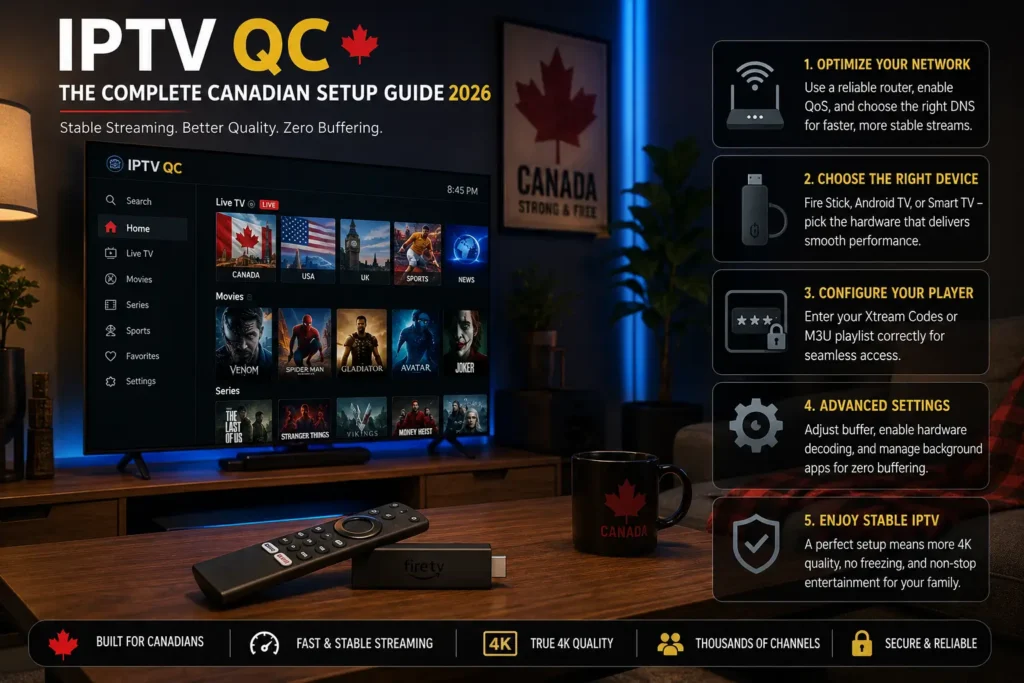
Most people only change IPTV after getting tired of fixing problems
At first, it feels like a small issue. A channel loads slowly. The app freezes once or twice. Then suddenly every movie night turns into ten minutes of buffering and restarting apps instead of actually watching something.
That frustration is one reason more Canadian viewers started testing iptv qc during 2026 on Fire Stick, Android TV and Smart TVs. People are no longer looking only for channels anymore. They want a setup that feels stable every evening without constant troubleshooting.
For many households, iptv qc became popular because the overall experience feels cleaner once everything is configured properly. Faster menus, smoother playback and better navigation are usually the first things users notice after switching.
Anyone comparing modern IPTV environments and streaming setups in Canada can also explore more Canadian streaming solutions on Best Canada IPTV.

Throughout this guide, we will break down how iptv qc works, why more viewers are moving towards iptv qc, and what actually improves streaming quality across Canada during 2026.
The strange part is that buffering usually starts at the same time every night
A lot of Canadian viewers notice the pattern eventually.
Everything works perfectly during the afternoon, then somewhere around the evening the entire setup suddenly feels heavier. Channels open slower, menus become laggy and streams start buffering for no obvious reason.
That is one reason more users started experimenting with better configured iptv qc setups during 2026 instead of constantly switching between random apps and playlists.
Sometimes the internet speed is not the real problem
People love checking speed tests the moment something buffers.
But many streaming issues connected to iptv qc actually come from overloaded servers, weak hardware or poor app optimisation rather than raw internet speed itself.
Several Canadian users noticed their Fire Stick worked much better after:
- clearing cache regularly
- reducing background apps
- restarting the router weekly
- switching to lighter IPTV players
Simple changes, honestly, but enough to completely change how iptv qc feels during daily use.
Anyone exploring more IPTV environments and streaming setups in Canada can also compare additional options on Canadian IPTV providers and streaming solutions.
ISP throttling still affects many Canadian homes
This part frustrates people the most because it is difficult to notice immediately.
Some internet providers quietly slow streaming traffic during busy evening hours to reduce pressure on their networks. That means iptv qc might suddenly buffer even though the broadband package itself looks fast on paper.
Several viewers in Canada only realised this after testing VPN connections and noticing their streams became smoother afterwards.
Old hardware quietly creates half the problems
A lot of users spend hours changing playlists when the real issue is simply an outdated device.
Older streaming boxes often struggle with:
- HD decoding
- large playlists
- heavy EPG loading
- modern IPTV applications
That is why many users running iptv qc moved towards newer Fire TV Stick models or Android TV devices during 2026.
The difference in responsiveness is usually obvious almost immediately.
What usually causes IPTV instability at home
| Problem | What users normally notice |
|---|---|
| ISP throttling | Evening buffering |
| Old streaming devices | Slow menus and freezing |
| Full cache storage | App crashes and lag |
| Weak Wi‑Fi signal | Random stream interruptions |
Most people stop chasing the cheapest setup after a while
That is something many long‑term IPTV users eventually realise.
The cheapest setup often becomes the most frustrating one over time. Weak hardware, overloaded apps and unstable playlists usually create constant maintenance problems.
Many households using iptv qc now focus more on stability and cleaner streaming environments instead of simply chasing low prices.
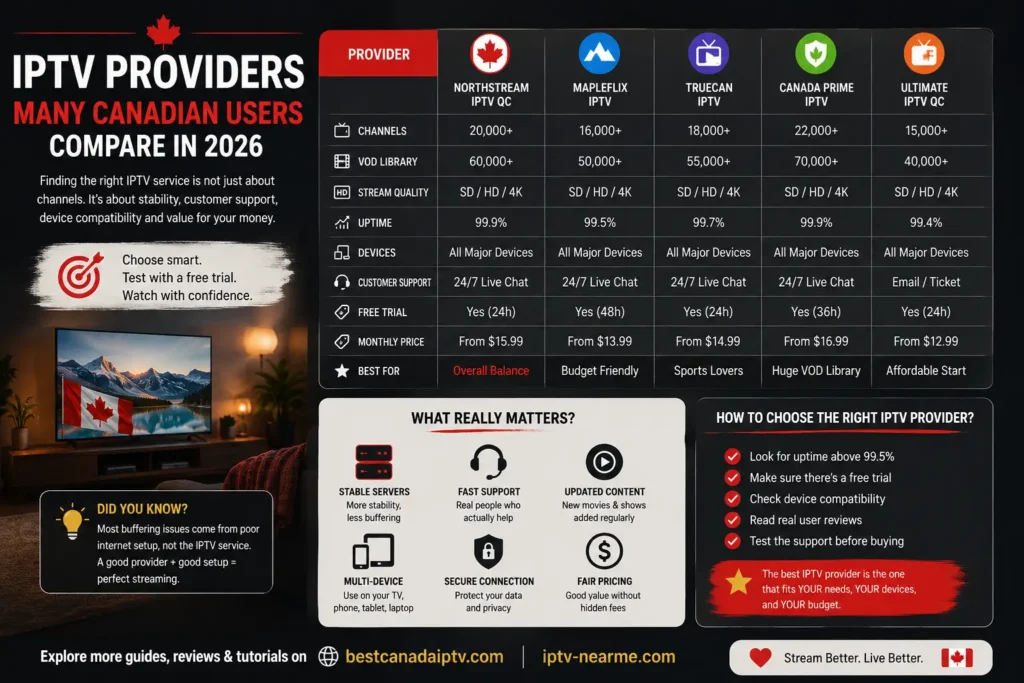
IPTV providers many Canadian users compare in 2026
Several names keep appearing frequently among Canadian IPTV communities when people discuss smoother streaming setups and easier device compatibility:
| Provider | What people usually mention |
|---|---|
| BestCanadaIPTV | Popular for Fire Stick and Canadian setups |
| IPTV-NearMe | Often discussed for Smart TV compatibility |
Many users comparing iptv qc environments also explore:
The interesting part is that most viewers now care less about huge channel counts and more about whether the entire setup feels stable every evening without constant troubleshooting.
And honestly, that is exactly why better configured iptv qc environments continue growing across Canada during 2026.
A fast internet plan does not automatically mean smooth streaming
That is something many Canadian users discover after spending good money on high-speed packages.
Everything looks perfect on paper, yet iptv qc still buffers randomly during the evening or channels suddenly take forever to load.
Most of the time, the issue sits inside the home network itself.
Your router controls more than people realise
A lot of viewers never touch their router settings after installation.
But modern routers include features that can seriously improve iptv qc stability when configured properly.
One of the biggest examples is QoS.
When enabled correctly, it tells the router to prioritise streaming traffic before background downloads, gaming updates or cloud syncing.
Several Canadian households using iptv qc noticed smoother playback almost immediately after prioritising their Fire Stick or Android TV device.
People comparing more Canadian IPTV environments and setup methods can also explore extra streaming guides on Best IPTV setups in Canada.
DNS settings quietly affect loading speeds
This is another detail many people completely ignore.
Slow DNS servers delay how quickly apps connect to streaming sources. That delay might only last a second or two, but after a while the entire experience feels heavier.
Several users running iptv qc switched to faster public DNS providers and noticed:
- quicker channel loading
- faster menu response
- smoother EPG refreshes
- fewer connection errors
Small adjustments, honestly, but enough to make the setup feel more responsive every day.
4K streaming exposes weak networks instantly
A standard HD stream hides many network problems.
But once people start watching higher bitrate content through iptv qc, weak Wi‑Fi and unstable routers become obvious very quickly.
That is why many experienced users now test:
- download speed at different hours
- latency consistency
- Wi‑Fi congestion levels
- packet loss during evening traffic
The goal is not just speed anymore. Stability matters much more.
Hardware still changes everything
A good IPTV setup feels completely different on stronger hardware.
People using iptv qc on older Smart TVs often notice slower menus and heavier navigation compared to newer Fire Stick or Android TV setups.
The difference becomes especially noticeable after several apps and playlists are installed.
Devices many Canadian users prefer in 2026
| Device | Why users keep choosing it |
|---|---|
| Fire TV Stick | Simple setup and reliable streaming |
| Android TV Box | Better power for multitasking and 4K |
| Smart TV Apps | Easy everyday access without extra devices |
Fire Stick still dominates for simplicity
Many users continue choosing Fire Stick because iptv qc feels lightweight and easy to manage on it.
Installation is fast, updates are simple and navigation stays smooth when the device is maintained properly.
At the same time, Android TV boxes remain popular among users who want more storage, stronger processors and better long‑term flexibility.
Internal Smart TV apps are convenient… until they slow down
This happens more often than people expect.
A Smart TV might work perfectly for months, then menus gradually become sluggish because storage fills up and background apps keep running.
Several users running iptv qc improved performance simply by:
- clearing cache regularly
- updating firmware
- removing unused apps
- restarting the TV weekly
Simple maintenance routines like these often improve streaming more than people realise.
And honestly, that is what separates frustrating setups from setups that simply work every evening without constant troubleshooting.

Most IPTV setups feel messy because nobody organizes them properly
That is honestly one of the biggest differences people notice after spending time with iptv qc.
When the app, playlists and categories are configured correctly, the entire setup suddenly feels lighter and much easier to use every day.
Menus respond faster, channels load cleaner and navigation stops feeling like a chore.
The app you choose changes everything
Many Canadian users spend weeks testing different players before finding one that actually feels stable long term.
Some apps look modern but become heavy after a few days. Others feel basic but handle streaming much better during busy evening hours.
Several users running iptv qc currently prefer:
- TiviMate
- IPTV Smarters
- IBO Player
- SmartOne IPTV
Mostly because these apps remain smoother on Fire Stick, Android TV and Smart TVs when playlists become larger.
Anyone comparing IPTV apps and setup methods can also explore additional Canadian installation guides on Best Canada IPTV tutorials and setup guides.
Xtream Codes usually feels faster than giant playlists
A lot of users still rely on huge M3U files packed with thousands of categories they never open.
Over time, that slows everything down.
Several Canadian viewers noticed iptv qc became far more responsive after switching to properly configured Xtream Codes instead of overloaded playlists.
Menus opened quicker, channels authenticated faster and the overall interface felt much cleaner.
What users usually notice after optimising their player
| Before optimisation | After optimisation |
|---|---|
| Slow startup | Faster loading |
| Heavy navigation | Smoother menus |
| Random freezes | Better stability |
| Delayed EPG updates | Faster synchronisation |
Favourite lists quietly improve the whole experience
This is something experienced IPTV users almost always do.
Instead of scrolling through hundreds of categories every evening, they create smaller favourites sections inside iptv qc.
That tiny change alone makes navigation feel dramatically faster.
Several users also hide categories they never watch to keep the interface clean and lightweight.
Cache buildup slowly makes apps feel heavier
It usually happens gradually.
At first everything feels fast. Then after a few weeks the app starts lagging slightly, menus delay for a second and channels take longer to open.
Many users running iptv qc fix this simply by clearing app cache once a month.
It sounds too simple, honestly, but it genuinely helps maintain smoother performance.
Updates matter more now than they used to
Modern IPTV apps evolve constantly during 2026.
Older versions sometimes struggle with newer streaming protocols, which creates connection errors and slower playback.
That is why experienced users running iptv qc regularly update:
- streaming apps
- Fire Stick firmware
- Android TV systems
- EPG synchronisation settings
Small maintenance habits prevent bigger problems later
| Maintenance Habit | Why users still do it |
|---|---|
| Cache cleanup | Keeps menus responsive |
| Playlist cleanup | Faster navigation |
| Firmware updates | Better compatibility |
| Removing unused apps | More available storage |
The interesting thing is that most stable IPTV setups are not built through complicated technical tricks.
Usually, people using iptv qc successfully just keep their setup clean, organised and updated instead of constantly installing random apps and overloaded playlists.

Most people never touch advanced settings… and that is usually why streams stay unstable
A lot of viewers install an IPTV app once, leave every setting on default and hope everything magically works forever.
Then the buffering starts.
That is where many users begin realising how much smoother iptv qc becomes once the player is actually configured properly.
Buffer settings quietly change the entire experience
This is one of the first things experienced IPTV users usually adjust.
A slightly larger buffer gives iptv qc more time to preload video data before playback catches up. That extra breathing room helps prevent those tiny freezes and annoying micro‑stutters people often notice during busy evening traffic.
Several Canadian users testing different configurations found that increasing buffer settings made iptv qc feel dramatically more stable on Fire Stick and Android TV.
Anyone exploring more advanced IPTV setup methods can also compare extra optimisation guides on Canadian IPTV setup and streaming optimisation tutorials.
Hardware decoding makes modern streams feel lighter
A lot of people do not even realise this option exists.
When hardware decoding is enabled, the device graphics processor handles video playback instead of forcing the main CPU to do all the work.
The result is usually:
- smoother motion
- lower device temperatures
- fewer dropped frames
- better 4K playback
Several viewers running iptv qc noticed immediate improvements after enabling hardware acceleration inside their IPTV player.
Background apps quietly drain performance
This problem is extremely common on Android TV devices.
People install dozens of apps over time, forget about them completely and eventually wonder why the system suddenly feels heavy.
Many users running iptv qc improved playback simply by:
- closing unused apps
- restarting the device weekly
- limiting background processes
- removing old streaming apps
Simple maintenance like this often stabilises the entire setup.
The most common IPTV problems are usually easy to recognise
| Problem | What users usually see |
|---|---|
| Weak buffering settings | Random micro‑freezes |
| Disabled hardware decoding | Choppy video playback |
| Overloaded Android system | Laggy menus and crashes |
| Incorrect login details | Authentication failures |
Sometimes restarting the network fixes everything
People underestimate how often routers simply become overloaded after weeks without restarting.
Several households using iptv qc noticed huge improvements after performing a complete router and modem reboot.
The connection felt cleaner, channels loaded faster and playback became more consistent afterwards.
Most playback issues come from small mistakes
A hidden space inside login credentials.
An outdated playlist.
An expired server URL.
A heavy app cache.
Tiny details like these are often enough to make iptv qc feel unstable even when the service itself is working correctly.
That is why experienced users usually troubleshoot methodically instead of instantly blaming the provider.
Stable IPTV setups are usually built through consistency
That is probably the biggest thing long‑term users learn after spending time with iptv qc.
The best streaming environments are rarely the most complicated.
Usually they are simply:
- properly maintained
- updated regularly
- connected to stable networks
- running clean IPTV players
- organised with lightweight playlists
Once all those pieces work together properly, iptv qc stops feeling like a technical project and simply becomes part of everyday entertainment.
Eventually, the setup disappears into the background
That is honestly the point most viewers want to reach.
You open the app.
Channels load quickly.
Menus feel responsive.
Everything simply works.
A properly configured iptv qc environment should never force people to spend half the evening troubleshooting frozen channels or restarting apps repeatedly.
And during 2026, that level of stability is becoming far more important to Canadian viewers than massive channel counts or flashy interfaces.
Questions people still ask before optimising IPTV setups
Why does IPTV QC perform better after changing buffer settings?
Because larger buffers help iptv qc absorb temporary internet fluctuations before playback gets interrupted.
Is hardware decoding important for 4K playback?
Yes. Many users running iptv qc notice smoother playback and lower device strain once hardware acceleration is enabled.
Why do Android TV devices become slower over time?
Background apps, cache buildup and full storage gradually reduce performance. Regular maintenance keeps iptv qc much more stable.
Can router restarts genuinely improve streaming?
Surprisingly, yes. Several households using iptv qc noticed fewer interruptions after restarting overloaded routers and modems.
Why do login errors happen even with correct subscriptions?
Small formatting mistakes inside Xtream Codes or outdated playlists often prevent iptv qc from authenticating correctly.
DMCA Disclaimer
This article is intended strictly for educational and informational purposes related to IPTV applications, streaming devices and network optimisation. This website does not host, distribute or store any media streams or copyrighted broadcasts. Users are solely responsible for the services and content accessed through third‑party providers and playlists.
