

Streaming is no longer something we plan our day around, it quietly fits into whatever moment we have. Behind that ease, there is usually a simple system doing the heavy lifting. One of the most common pieces of that system is iptv m3u, even if most people don’t realize it at first.
An iptv m3u playlist is basically a structured list of streaming links gathered into one file. Instead of opening dozens of separate streams, everything is organized in a single place and sent directly to the app or device you are using. That is why this format became so popular in internet TV environments.
What makes iptv m3u practical is how flexible it is. The same playlist can work across different devices and applications without much effort. Users simply load the file, and the content becomes accessible instantly. This approach is often explained in more detail on platforms like the Best Canada IPTV homepage, where playlists are treated as the backbone of modern streaming setups.

In simple terms, iptv m3u is not a service by itself. It is a format that helps organize and deliver content smoothly, which is exactly why it plays such an important role in how IPTV works today.
IPTV M3U as people actually experience it
Most explanations about playlists feel copied and overworked. In real usage, iptv m3u is far more subtle than that. You never open it to read it, and you never think about its structure. You only notice the result. Channels load in order, categories make sense, and streaming feels predictable instead of random.
When an iptv m3u playlist is working properly, the experience feels effortless. You scroll, you select, you watch. There is no sense of dealing with files or formats, because the playlist is already doing that job quietly in the background.
What IPTV M3U really does behind the screen
At a practical level, iptv m3u acts like a roadmap for IPTV applications. It tells the app where each stream lives and how it should be presented. Without that roadmap, applications would have no idea how to display content in a usable way.
This is also where many beginners get confused. iptv m3u is not a service and it is not content by itself. It is only a format. Once that idea is clear, the rest of IPTV becomes much easier to understand. This relationship between playlists and applications is explained clearly in the IPTV service explained article, which focuses on how all the pieces fit together.
The one breakdown that actually helps
This is the only moment where breaking things down makes sense:
- iptv m3u groups multiple streaming sources into one readable file
- The file stays simple so it remains compatible across apps and devices
- Applications rely on it to keep channels organized and stable
Once this part works correctly, users rarely have to think about playlists again.
Why IPTV M3U keeps its place over time
Applications change. Devices evolve. Interfaces get redesigned. iptv m3u stays because it solves a basic problem that never goes away, organization. It keeps large amounts of streaming content structured without pushing complexity onto the viewer.
That quiet reliability is the reason iptv m3u continues to sit at the center of IPTV setups today, doing its job without asking for attention.
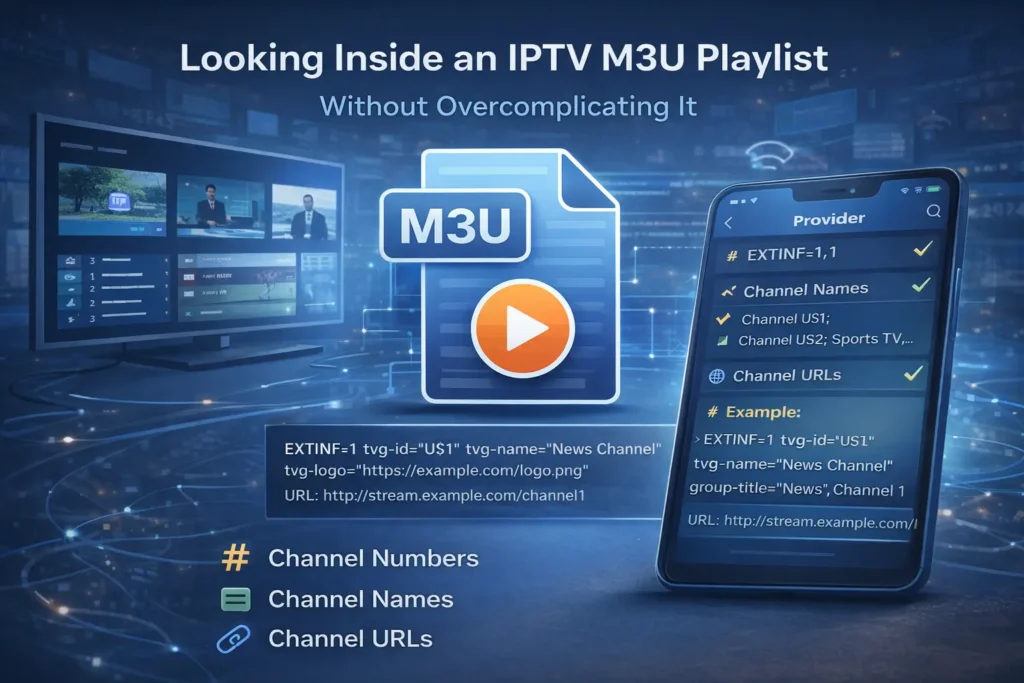
Looking inside an IPTV M3U playlist without overcomplicating it
When people hear about file structures and formats, they usually expect something technical. In reality, iptv m3u playlists are designed to stay simple. They exist to help applications understand what to show and how to show it, nothing more.
An iptv m3u playlist is basically a text-based file that mixes two things together, information and stream locations. The information tells the app how a channel should appear, while the link tells it where to fetch the stream. That balance is what allows IPTV players to feel organized instead of messy.
How an IPTV M3U file is put together
Inside an iptv m3u file, everything follows a predictable rhythm. The file starts with a marker that identifies it as a playlist, then continues with repeated blocks of details and stream links. These details are not decoration. They help players label channels, group them correctly, and keep navigation consistent.
What matters most is not the exact syntax, but the logic behind it. When the metadata is clean, apps know how to present content properly. When it is not, channels appear broken, unnamed, or misplaced. This is why playlists are often checked first when troubleshooting, a point also mentioned in setup explanations like the installation tutorials.
M3U vs M3U8, why both exist
You will often see iptv m3u playlists shared in two formats. The difference is not about features, but about compatibility. M3U8 uses a modern text encoding that handles different languages and symbols more reliably. That makes it easier for playlists to work across regions and devices without display issues.
For most users, this difference stays invisible. Players simply load the playlist and play content. But behind the scenes, the encoding choice helps prevent small errors that can turn into bigger problems.
IPTV M3U compared to IPTV subscriptions
This is where confusion usually happens. iptv m3u playlists and IPTV subscriptions are related, but they are not the same thing.
An iptv m3u playlist is a format. It organizes streams and tells applications how to display them. An IPTV subscription, on the other hand, is a managed service that usually provides content, updates, and additional features.
The main difference can be felt in daily use:
- Playlists give flexibility but require manual management
- Subscriptions offer convenience through ready-made structures
Understanding this distinction helps users choose what fits their habits instead of mixing concepts that serve different roles.
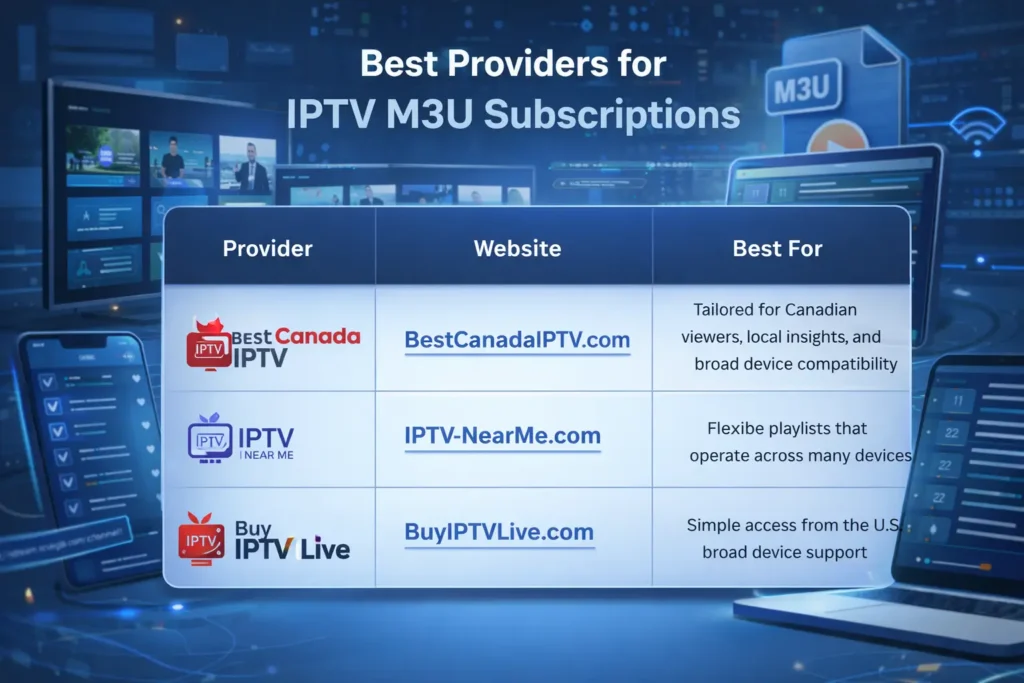
Best Providers Offering IPTV M3U Subscriptions
When it comes to choosing a provider that supports IPTV M3U playlists properly, the difference is often in stability, playlist updates, and how easily the service works with common players. Below is a clear comparison of providers that are commonly used for M3U-based subscriptions.
| Provider | Region Focus | M3U Playlist Support | Device Compatibility | Best For |
|---|---|---|---|---|
| BestCanadaIPTV.com | Canada | Full M3U access with frequent updates | Smart TVs, mobile devices, computers | Users looking for stable M3U playlists tailored for Canadian streaming needs |
| IPTV-NearMe.com | Multi-region | Flexible M3U playlists | Android, iOS, Smart TVs, PCs | Viewers who want adaptable playlists that work across multiple devices |
| Bestsubscriptioniptv.com | USA & International | Direct M3U integration | Firestick, Smart TVs, mobile devices | Users who prefer simple setup and broad device support |
Each of these providers focuses on making IPTV M3U playlists easy to use, whether your priority is regional content, device flexibility, or smooth playback. Choosing the right one depends on how and where you plan to stream.

Ownership and Control Considerations
When using IPTV M3U playlists, users have more control over the content they access, as they can curate their playlists and switch between different providers or sources. However, this also means that users are responsible for ensuring the quality and legality of the content.
“The flexibility to manage your own IPTV M3U playlists can be both a blessing and a curse, as it requires technical know-how and can expose users to potential risks if not done correctly.”
IPTV subscriptions, on the other hand, offer a more controlled environment where the provider is responsible for the content quality and delivery. However, this comes at the cost of less flexibility for the user.
Cost and Flexibility Factors
IPTV M3U playlists can often be more cost-effective, as users can choose from various free or low-cost sources. However, the quality and reliability of these sources can vary significantly.
Cost considerations:
- IPTV subscriptions usually come with a monthly or annual fee, which can be more predictable in terms of cost.
- Some IPTV M3U playlists may require a one-time payment or subscription to a specific service, but they can also be found for free, albeit with potential risks.
In terms of flexibility, IPTV M3U playlists can be used on a variety of devices with compatible media players, making them highly versatile. IPTV subscriptions, while also accessible on multiple devices, may have more restrictions based on the provider's policies.
Ultimately, the choice between IPTV M3U playlists and IPTV subscriptions depends on the user's priorities regarding cost, control, and content quality.
How to Use IPTV M3U Playlists on Different Devices
Accessing IPTV M3U playlists across various devices is simple and convenient. With the flexibility to stream content on smart TVs, mobile devices, and computers, you can enjoy your favorite shows and movies anywhere, especially when using proper setup methods explained in these IPTV installation tutorials
Setting Up M3U Playlists on Smart TVs
To set up an IPTV M3U playlist on your smart TV, you'll typically need to use a compatible media player app. Many modern smart TVs come with built-in media players that support M3U files.
- Download and install a media player app that supports IPTV M3U playlists.
- Launch the app and navigate to the settings or configuration section.
- Enter the URL of your IPTV M3U playlist or upload the M3U file.
Mobile Device Configuration Steps
Configuring IPTV M3U playlists on mobile devices is relatively straightforward. You can use apps designed for IPTV streaming.
- Download an IPTV player app from your device's app store.
- Open the app and look for the option to add an M3U playlist.
- Enter the URL of your IPTV M3U playlist.
Computer and Media Player Setup
On computers, you can use media player software that supports IPTV M3U playlists.
Windows Configuration
For Windows users, popular media players like VLC can be used to play IPTV M3U playlists.
- Download and install VLC media player.
- Open VLC and navigate to the “Media” menu.
- Select “Open Network Stream” and enter the URL of your IPTV M3U playlist.
macOS Configuration
macOS users can also use VLC or other compatible media players to stream IPTV M3U content.
- Download and install VLC media player for macOS.
- Launch VLC and go to the “File” menu.
- Choose “Open Network” and enter the IPTV M3U playlist URL.
By following these steps, you can easily set up and enjoy IPTV M3U playlists on a variety of devices, enhancing your streaming experience.
Streaming Quality and IPTV M3U Performance
Understanding the streaming quality options available in IPTV M3U playlists is crucial for an optimal viewing experience. The quality of your IPTV streaming is directly influenced by the specifications of your M3U playlist, including the available streaming qualities and the bandwidth requirements.
SD, HD, and 4K Options in M3U Playlists
IPTV M3U playlists typically offer various streaming quality options, including Standard Definition (SD), High Definition (HD), and 4K resolution. SD is the lowest quality, with a resolution of 720×576 pixels, while HD offers higher quality at 1280×720 pixels or 1920×1080 pixels. 4K, also known as Ultra HD, provides the highest quality at 3840×2160 pixels, offering a more detailed and immersive viewing experience.
The availability of these options in an M3U playlist depends on the content provider and the source of the playlist. When selecting a playlist, it's essential to check which quality options are available to ensure they meet your viewing needs.

Bandwidth Requirements for Different Quality Levels
The bandwidth required for smooth IPTV streaming varies significantly with the chosen quality level. Here's a breakdown of the typical bandwidth requirements:
| Quality Level | Resolution | Bandwidth Requirement |
|---|---|---|
| SD | 720×576 | 2-5 Mbps |
| HD | 1280×720 or 1920×1080 | 5-10 Mbps |
| 4K | 3840×2160 | 25-50 Mbps |
Ensuring your internet connection meets these bandwidth requirements is crucial for uninterrupted streaming.
Optimizing Playback Performance
To optimize IPTV M3U playback performance, consider the following tips:
- Ensure your internet bandwidth is sufficient for the chosen streaming quality.
- Use a reliable IPTV player that supports M3U playlists.
- Regularly update your M3U playlist to access the latest stream links.
- Configure your IPTV player settings for optimal performance, such as adjusting buffer settings.
By following these guidelines, you can significantly enhance your IPTV streaming experience, enjoying your favorite content with minimal interruptions.
Troubleshooting Common IPTV M3U Issues
IPTV M3U users may face several common problems that can be easily resolved with the right troubleshooting steps, and many of these practical questions are also clarified in the IPTV FAQ section for users who want quick, clear answers. Understanding these issues and their solutions can significantly enhance your streaming experience.
Dealing with Buffering Problems
Buffering is a common issue that can be caused by a variety of factors, including internet connection speed and server overload. To resolve buffering problems, ensure that your internet connection meets the minimum speed requirements for your chosen streaming quality.
If buffering persists, try switching to a different server or adjusting your streaming quality to a lower setting. Additionally, using a wired connection instead of Wi-Fi can help stabilize your connection and reduce buffering.
Resolving Playlist Loading Failures
Playlist loading failures can occur due to incorrect M3U file formatting or issues with the playlist URL. To troubleshoot this issue, verify that your M3U file is correctly formatted and that the URL is valid and accessible.
If the problem persists, try reloading the playlist or checking for updates from your IPTV provider. Ensuring that your media player or IPTV app is up-to-date can also help resolve loading issues.
Updating Outdated Playlists
Outdated playlists can lead to content not being updated or channels not working. To update your IPTV M3U playlist, check with your IPTV provider for the latest playlist URL or file.
Regularly updating your playlist ensures that you have access to the latest content and channels. Some IPTV apps and media players also offer automatic update features for playlists.
Compatibility Issues and Solutions
Compatibility issues can arise when using IPTV M3U playlists with different devices or media players. To address these issues, ensure that your device or media player supports the M3U format and is compatible with your IPTV service.
Using a compatible media player or IPTV app can help resolve compatibility issues. Additionally, checking for firmware updates for your device can improve compatibility and overall performance.
Conclusion
Understanding IPTV M3U playlists is crucial for a seamless streaming experience. By grasping how these playlists work, you can unlock a world of entertainment options tailored to your preferences, especially when combined with proper setup steps explained in the IPTV installation tutorials
Using IPTV M3U playlists effectively requires choosing the right iptv m3u players and configuring them correctly on your devices, whether it's a smart TV, mobile device, or computer. This flexibility is one of the key benefits of IPTV M3U technology.
As you've learned, iptv m3u playlists offer a range of advantages, including flexibility and control over your streaming content. By selecting the right iptv m3u playlist and configuring it to suit your viewing habits, you can enjoy a superior streaming experience.
To get the most out of your iptv m3u playlist, consider factors such as streaming quality, device compatibility, and playlist updates. By doing so, you can ensure a smooth and enjoyable viewing experience.
FAQ
What is an IPTV M3U file, and how does it work?
An IPTV M3U file is a playlist file that contains links to IPTV channels, allowing users to stream content to their devices. It works by providing a list of URLs that point to the streaming sources, which are then accessed by IPTV apps or players.
What is the difference between M3U and M3U8 formats?
M3U and M3U8 are both playlist formats used for IPTV streaming. The main difference is that M3U8 is an extended version of the M3U format, supporting additional features such as character encoding and improved compatibility with certain devices.
How do I set up an IPTV M3U playlist on my device?
To set up an IPTV M3U playlist, you'll need to download an IPTV app or player that supports M3U files, then load the M3U playlist into the app. The specific steps may vary depending on the device and app you're using.
Can I use IPTV M3U playlists on multiple devices?
Yes, IPTV M3U playlists can be used on multiple devices, including smart TVs, mobile devices, and computers, as long as you have a compatible IPTV app or player installed.
What are the bandwidth requirements for streaming IPTV content using M3U playlists?
The bandwidth requirements for streaming IPTV content depend on the quality of the stream, with SD streams requiring around 3-5 Mbps, HD streams requiring 5-10 Mbps, and 4K streams requiring 25 Mbps or more.
How do I troubleshoot buffering problems with my IPTV M3U playlist?
To troubleshoot buffering problems, check your internet connection speed, ensure that your device meets the minimum requirements for the IPTV app or player, and try adjusting the stream quality to a lower setting.
Are IPTV M3U playlists compatible with all IPTV services?
No, IPTV M3U playlists are not compatible with all IPTV services. Some services may use proprietary formats or have specific requirements for M3U playlists, so it's essential to check compatibility before using an M3U playlist.
How often should I update my IPTV M3U playlist?
The frequency of updating your IPTV M3U playlist depends on the provider and the playlist itself. Some playlists may be updated regularly by the provider, while others may require manual updates.
