
TV used to feel straightforward. Then came buffering, random drops in quality, and that quiet frustration of never knowing if a stream would hold. That’s honestly when IPTV Professional started to make sense for me, not as a buzzword, but as a real shift in how television is consumed today.
Everything now runs through the internet, and that alone changes the rules. What separates IPTV Professional from basic setups is reliability. Streams stay smooth, quality doesn’t randomly collapse, and watching for hours doesn’t turn into a gamble. That kind of consistency usually comes from solid infrastructure and smarter delivery, not luck.
A lot of people mix things up here. IPTV Professional isn’t about stacking features, it’s about removing friction. Getting a clear picture of how a full professional iptv environment is structured, especially at the platform level, helps put things into perspective.
Once that stability becomes normal, going back to unstable viewing feels strange.

Why Television Feels Different Today
Television didn’t suddenly change overnight. It shifted slowly. One update at a time. One missed moment because of buffering. One drop in quality that made you ask yourself if this was really the best option anymore. That’s usually the moment when people start looking into IPTV Professional, not out of curiosity, but out of necessity.
What matters most here is control. Viewers want something that works when they press play, not something that needs patience.
What IPTV Professional Actually Is
At its core, IPTV Professional is television delivered through the internet instead of traditional broadcast methods. But saying that alone doesn’t explain much. The real difference shows up in how the content is handled before it ever reaches the screen.
- Content is delivered in real time through optimized networks
- Streams adjust smoothly instead of breaking under pressure
- Quality remains consistent across long viewing sessions
This approach removes many of the issues people accepted for years as “normal TV problems.”
The Technology Behind the Experience
IPTV Professional relies on a layered system that works quietly in the background. Content is collected, encoded, and distributed through multiple servers designed to balance load and reduce delay. Nothing is pushed blindly. Everything is calculated.
That’s why buffering becomes rare and sudden drops feel less common. The system adapts instead of collapsing.
How It Compares to Traditional Television
The difference becomes obvious once you compare both side by side.
| Aspect | Internet-Based IPTV | Traditional TV |
|---|---|---|
| Delivery method | Adaptive streaming | Fixed broadcast |
| Viewing stability | Adjusts to connection | Drops when signal weakens |
| Device flexibility | Multiple devices | Limited hardware |
Traditional TV sends the same signal to everyone. Internet-based delivery responds to each viewer individually. That flexibility is what most people notice first.
Where Pricing Comes Into the Picture
Once people understand how the system works, the next question is always about value. Not the cheapest option, but what actually feels worth paying for. A well-structured pricing model reflects the stability, infrastructure, and long-term reliability behind the service.
Looking at how different plans are structured helps clarify what level of access and performance makes sense for your usage habits.
How Pricing Actually Makes Sense
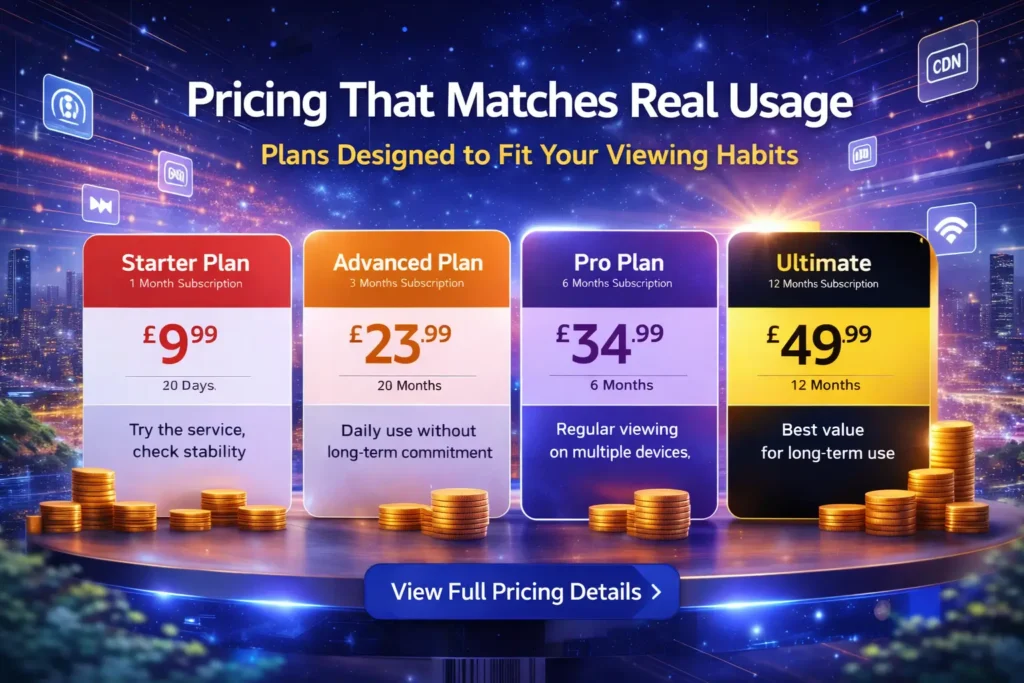
Pricing is usually where people pause and think. Not because they want the cheapest option, but because they want something that stays reliable over time. With IPTV Professional, pricing is tied to usage patterns, not hype or artificial features.
Here’s a clear look at how pricing is usually structured:
| Plan Duration | Typical Use | Why It Fits |
|---|---|---|
| 1 Month | Testing or short-term use | Low commitment, easy to try |
| 3 Months | Regular home viewing | Better balance of cost and stability |
| 6 Months | Daily or multi-device use | More value with consistent performance |
| 12 Months | Long-term or shared use | Best value over time |
Seeing how plans are positioned helps set realistic expectations. If you want to review current offers and how they’re laid out, checking the available subscription pricing gives a straightforward overview.
The real question isn’t the price itself, it’s whether the service feels dependable enough to keep.
Apps and VPNs That Actually Work Well
Even the most stable service depends on the tools you use to access it. IPTV Professional works best with applications that are responsive, well-maintained, and designed for long viewing sessions.
Popular IPTV apps many users rely on include TiviMate, IPTV Smarters, SmartOne IPTV, and IBO Player. These apps are known for clean interfaces, smooth channel switching, and stable performance across different devices.
VPNs are often used as an extra layer of privacy and connection consistency. Reliable options commonly chosen include NordVPN, and CyberGhost. Used correctly, a VPN can help maintain steady access without interfering with streaming quality.
The key is simplicity. One solid app, one reliable VPN if needed, and minimal tweaking.
For readers curious about how these tools are combined in real viewing setups, this practical overview of IPTV usage setups explains common configurations without overcomplicating things.
When pricing feels fair and the right tools are in place, IPTV Professional becomes effortless rather than technical.

How Streams Actually Reach Your Screen
Most people never think about what happens between pressing play and seeing an image appear. That gap is where professional iptv really shows its strength. The system doesn’t just push data and hope for the best. It adapts.
Modern setups rely on smart streaming protocols that react to network conditions instead of fighting them. When the connection is strong, quality goes up. When it fluctuates, the stream adjusts quietly in the background. That’s why sudden freezes feel less common. Transmission methods are chosen based on context too. Some content is delivered directly to one viewer, other types are distributed more efficiently depending on demand. It’s all about balance, not brute force.
What matters here isn’t the technical names, it’s the result. Watching feels smooth instead of fragile. And that consistency is what separates IPTV Professional from improvised solutions.
Why Stability Becomes the Real Selling Point
People usually notice reliability before anything else. A service can look good on paper, but if it breaks during normal use, trust disappears fast. IPTV Professional is built around avoiding that situation.
- Backup systems keep streams alive when something fails
- Traffic is distributed instead of overloaded
- Downtime becomes rare rather than expected
This approach makes a difference not only at home, but also in environments where interruptions simply aren’t acceptable.
Quality That Doesn’t Feel Forced
Streaming quality isn’t just about high resolution labels. With IPTV Professional, clarity stays consistent because the system knows when to push and when to ease off. High-definition content feels natural instead of unstable. Long sessions don’t slowly degrade, they hold their line.
That’s usually the moment when people stop comparing and start committing. Not because it’s flashy, but because it feels dependable.
To understand how these performance levels are reflected across different usage scenarios, browsing real-world breakdowns in the Canadian IPTV landscape gives useful perspective without exaggeration.
Once stability and quality stop being concerns, the experience finally feels settled. And that’s when professional iptv quietly proves its value.

Watching Without Being Locked to One Screen
One thing people quickly appreciate with IPTV Professional is freedom. Not marketing freedom, real freedom. You’re not tied to a single screen in one room anymore. The same service follows you, whether you’re on the couch, at a desk, or checking something quickly on your phone.
That flexibility comes from broad device compatibility. IPTV Professional systems are designed to work across different environments without forcing complicated setups or constant tweaking. Once it’s configured properly, switching between devices feels natural.
How Different Devices Fit Into the Experience
Not every screen behaves the same, and that’s okay. IPTV Professional adapts to each use case instead of treating everything equally.
- Smart TVs offer the most comfortable long-session viewing
- Mobile devices work well for short, flexible access
- Computers handle multitasking and browser-based playback
- Dedicated IPTV boxes focus on stability and simplicity
The goal isn’t to use everything, it’s to use what fits your habits best.
Scaling From Personal Use to Bigger Needs
This is where IPTV Professional quietly separates itself from basic setups. What works for one person also works for ten, or a hundred. The system doesn’t break just because more screens are added.
That scalability matters for households that grow, shared spaces, and even professional environments. You don’t need to rebuild anything from scratch. The structure is already there.
Device Experience at a Glance
| Device Type | Compatibility Level | Setup Experience |
|---|---|---|
| Smart TVs | High | Simple |
| Mobile devices | High | Very easy |
| Computers | Medium | Straightforward |
| IPTV boxes | High | Plug-and-play |
This isn’t about buying the most expensive hardware. It’s about choosing what feels smooth and reliable day after day.
Getting the Setup Right
A good device only performs well if it’s set up properly. Small details matter here. Choosing the right application, matching settings to your connection, and avoiding unnecessary tweaks can make a noticeable difference.
For those who want a clear, step-by-step view of how setups usually work across different devices, these installation tutorials offer practical guidance without overcomplicating things.
Once the right device meets the right configuration, IPTV Professional stops feeling technical and starts feeling normal. And that’s usually the best sign you chose well.
Why Streaming Quality Is Never Just About Resolution
A lot of people assume streaming quality starts and ends with resolution. In reality, that’s only one piece of the puzzle. With IPTV Professional, performance depends on how well several elements work together, not just how sharp the image looks.
Internet stability, delivery technology, and how the stream reacts to changes all play a role. When those pieces are aligned, watching feels effortless. When they aren’t, even the highest resolution becomes frustrating.
Choosing the Right Quality Level for Your Setup
Not every screen or connection needs the same level of quality. IPTV Professional adapts to different situations instead of forcing one standard on everyone.
| Quality Level | Typical Use Case | Connection Expectation |
|---|---|---|
| SD | Small screens, casual viewing | Low and stable |
| HD | Everyday home viewing | Moderate |
| Full HD | Larger screens, longer sessions | Strong and consistent |
| 4K | Premium displays, detailed content | Very strong and stable |
The key is matching your device and connection instead of chasing the highest number available.
How Streams Stay Smooth When Connections Change
One of the quiet advantages of IPTV Professional is how it handles unstable internet moments. Instead of freezing or collapsing, the stream adjusts. Quality shifts slightly when needed, then recovers once the connection improves.
That adaptive behavior is what keeps viewing sessions watchable, even when network conditions aren’t perfect. Most users don’t notice the adjustment, which is exactly the point.
Why Security and Reliability Can’t Be Ignored
This is where IPTV Professional clearly separates itself from free or improvised options. Stability isn’t only about smooth playback, it’s also about trust.
Professional systems focus on:
- Secure access controls
- Protected user data
- Controlled delivery environments
Free alternatives often skip these layers. That can lead to unstable streams, unexpected interruptions, or worse, security risks that have nothing to do with entertainment.
Performance You Can Actually Rely On
Reliability comes from infrastructure, not promises. IPTV Professional relies on distributed servers and managed delivery networks designed to handle demand without breaking under pressure.
That’s why performance feels predictable. Streams start faster. Sessions last longer. And problems become exceptions instead of expectations.
For readers who want a broader look at how streaming performance and service quality compare across different setups, this overview of IPTV performance in Canada adds useful context without exaggeration.
When quality, security, and reliability work together, IPTV Professional stops feeling like technology and starts feeling like a dependable habit.
Wrapping It All Together
After spending time with IPTV Professional, one thing becomes clear very quickly. This isn’t about changing how television looks, it’s about changing how it behaves. Fewer interruptions. More consistency. Less time fixing problems that shouldn’t exist in the first place.
Once you understand what’s happening behind the scenes, from how content is handled to how streams are delivered and adjusted, the difference stops being theoretical. It becomes practical. Stability, image quality, and device flexibility stop being promises and start being part of everyday use.
For viewers in Canada especially, choosing a setup that’s built to last matters. Not because trends say so, but because habits form around what works. Exploring how a well-structured IPTV service in Canada is designed can help make that choice clearer without pressure or exaggeration.
Professional iptv doesn’t ask you to relearn television. It simply removes the friction that made watching feel complicated.
Frequently Asked Questions
What makes IPTV Professional different from traditional television?
Traditional TV pushes the same signal to everyone. Professional iptv adapts to each viewer’s connection, which results in smoother playback, better consistency, and more flexibility across devices.
How does professional iptv actually work day to day?
Content is delivered over the internet using managed systems that adjust stream quality in real time. Instead of breaking when conditions change, the stream adapts quietly in the background.
Is professional iptv limited to one type of device?
Not at all. It works across smart TVs, mobile devices, computers, and dedicated media players. The experience simply adjusts to the screen you’re using.
Why do people choose professional iptv over free alternatives?
Free options often look appealing at first, but they tend to come with instability and security concerns. Professional iptv focuses on reliability, controlled access, and predictable performance.
What kind of internet connection is needed?
Requirements depend on how you watch. Standard viewing needs far less bandwidth than ultra-high resolution setups. The key is consistency rather than raw speed.
Final Word
If television is part of your daily routine, reliability matters more than features. Professional iptv earns its place not by being flashy, but by being dependable. Once watching feels effortless again, the technology fades into the background, which is exactly how it should be.
DMCA Disclaimer
This website does not host, stream, or store any video, media files, or television content. All references are for informational and educational purposes only. We are not responsible for third-party content or external services accessed through links on this site. Users are solely responsible for ensuring their own compliance with local laws and regulations regarding content access and usage.
